Jewelry Guide
Jewelry Crafting allows characters to create jewelry from a variety of metals, cut and polish gemstones, engrave finished pieces, and set gemstones into compatible jewelry.
The system is made up of several related skills. Different recipes use different combinations of those skills, and only the skills actually used during the creation of an item contribute to its finished quality. As a result, mastering one type of jewelry does not necessarily require mastering every skill in the skillset.
How Jewelry Is Made
Jewelry recipes do not all follow the same production process.
The skills that affect the finished quality of a piece are only those actually used by that recipe.
For example, Assembly does not affect a forged ring unless that specific recipe contains an assembly step.
Broadly, jewelry production falls into several different processes.
Cast Jewelry
Cast jewelry begins with a wax form.
The general process is:
- Form the wax piece.
- Create a clay mold from the wax form.
- Bake the mold.
- Smelt the required metal.
- Cast the metal into the prepared mold.
- Perform any additional recipe steps.
- Optionally engrave the finished jewelry.
- Optionally set compatible gemstones.
Forged Jewelry
Other jewelry is produced by working metal stock rather than pouring molten metal into a mold.
The exact steps depend upon the recipe and may involve:
- Hot-working metal into the required stock.
- Cold-working the stock into components.
- Assembling components when required.
- Engraving the finished piece, if supported.
- Setting gemstones, if supported.
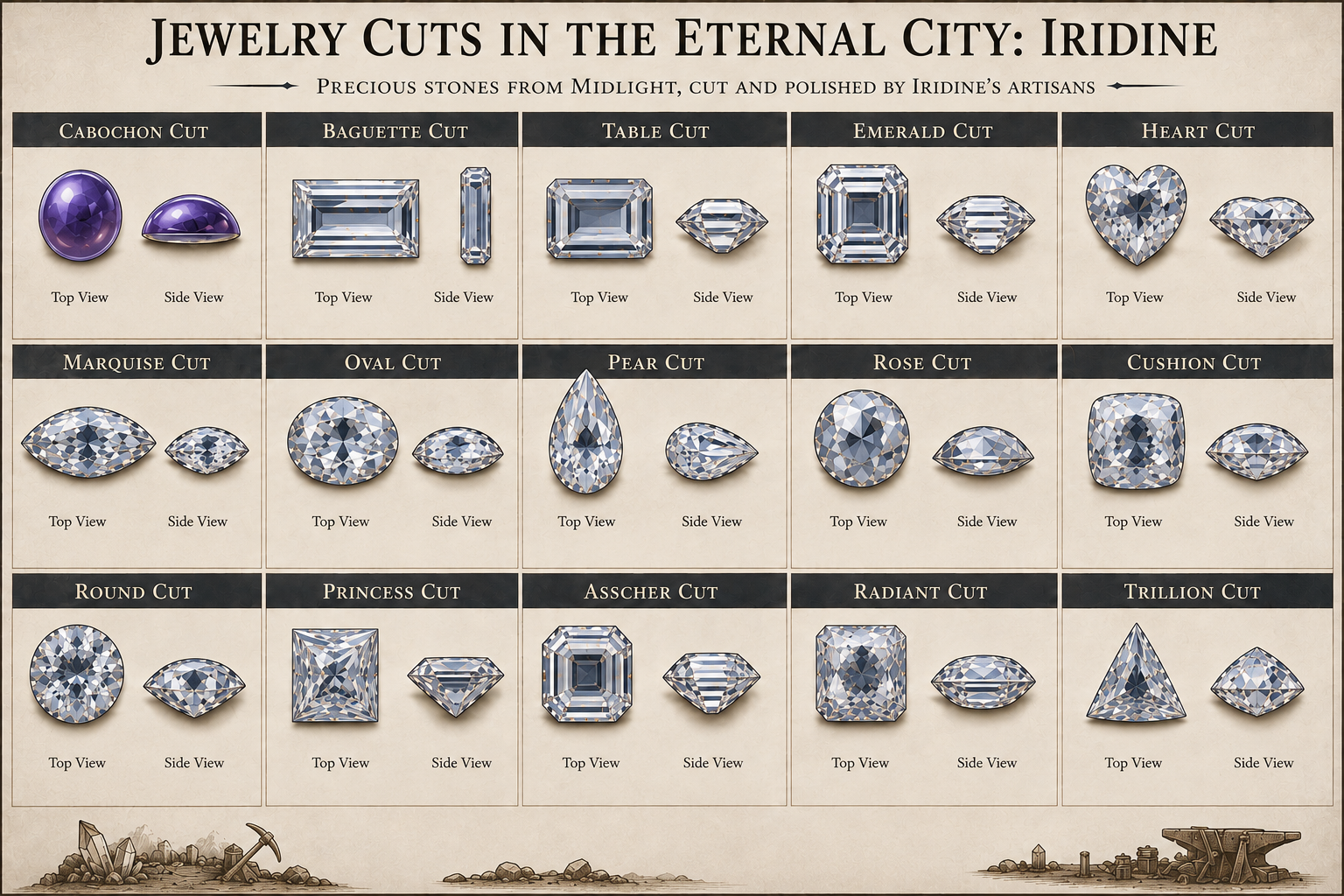
Gem Cutting
Gem cutting is its own multi-step process.
The general process is:
- Layout the intended cut.
- Rough cut the stone.
- Shape the required facets.
- Polish the finished gemstone.
Different cuts require different numbers of Rough Cut and Shape actions.
Metalworking Difficulty
| 1 | 2 | 3 | 4 | 5 | 6 | 7 | 8 | 9 |
|---|---|---|---|---|---|---|---|---|
| Tin | Copper \ Silver \ Gold | Brass | Bronze | Seelan | Iron | Alanti | Boison | Caon |
Easiest → Hardest
Higher-value metals can be substantially more profitable, but also require greater skill to work reliably. Material loss should therefore be considered when choosing what metal to use for training versus production.
Jewelry Recipes
The following tables list known finished jewelry recipes according to whether they may be engraved or set with gemstones.
Engravable & Gem Settable
| Jewelry Recipe | Max Gems |
|---|---|
| Broad Cast Bracelet | 10 |
| Broad Cast Ring | 5 |
| Cast Anklet | 1 |
| Cast Bangle | 10 |
| Cast Pendant | 1 |
| Cast Simple Band | 1 |
| Forged Anklet | 10 |
| Forged Bangle | 10 |
| Forged Simple Band | 1 |
| Forged Tiara | 5 |
| Ornate Forged Ring | 5 |
| Pendant Necklace | 1 |
| Simple Band Ring | 1 |
| Toe Ring | 1 |
Gem Settable Only
| Jewelry Recipe | Max Gems |
|---|---|
| Cast Stud Earrings | 2 |
| Drop Earrings | 2 |
| Eyebrow Ring | 1 |
| Lip Stud | 1 |
| Nose Stud | 1 |
Engravable Only
| Jewelry Recipe |
|---|
| Locket |
Neither
| Jewelry Recipe |
|---|
| Charm Anklet |
| Charm Bracelet |
| Charm Necklace |
| Fine Chain Necklace |
| Heavy Chain Necklace |
| Hoop Earrings |
| Lip Ring |
| Nose Ring |
| Septum Ring |
| Waist Chain |
| Wire Anklet |
| Wire Bracelet |
| Wire Earrings |
| Wire Necklace |
| Wire Ring |
Special Jewelry Notes
- Piercing jewelry is worn as a garment and does not require permanent piercing.
- Different piercing types occupy different layers, allowing different types to be worn simultaneously.
Metal Requirements by Recipe
| Slag Needed | Recipes |
|---|---|
| 1 | Cast Stud Earrings, Broad Cast Ring, Broad Cast Bracelet, Cast Simple Band, Cast Charm, Ornate Forged Ring, Forged Bangle, Forged Anklet, Cast Bangle, Cast Pendant, Simple Band Ring, Drop Earrings, Eyebrow Ring, Nose Ring, Nose Stud, Septum Ring, Lip Ring, Lip Stud, Forged Tiara, Wire Ring |
| 1 2/3 | Charm Bracelet (10 tiny links) |
| 2 | Wire Earrings, Wire Bracelet, Wire Anklet, Hoop Earrings |
| 3 | Wire Necklace |
| 3 1/3 | Fine Chain Necklace (20 tiny links) |
| 4 1/3 | Pendant Necklace (20 tiny links + 1 casting) |
| 5 1/6 | Waist Chain (31 tiny links) |
| 6 1/3 | Locket (20 tiny links + body + lid + hinge pin) |
| 10 | Heavy Chain Necklace (10 thick links) |
Tiny-link costs are amortized based on six tiny links being produced from one wire. Actual up-front material requirements may be higher when crafting a single item due to leftover links.
Material Costs
Common Metal Material Costs
| Lumps | Tin | Copper | Brass | Bronze | Iron | Silver | Gold |
|---|---|---|---|---|---|---|---|
| 1 | 1c 4d 1s | 2c 8d 2s | 3c 12d 1st | 4c 16d 1st 1s | 6c 24d 2st 1s | 9c 7d 3st | 19c 10d |
| 2 | 2c 8d 2s | 4c 16d 1st 1s | 6c 24d 2st | 9c 7d 2st 2s | 13c 24d 2s | 18c 15d 2st | 38c 20d |
| 3 | 3c 12d 1st | 6c 24d 2st | 10c 11d 3st | 13c 24d | 20c 23d 3st | 27c 23d 1st | 58c 5d |
| 4 | 4c 16d 1st 1s | 9c 7d 2st 2s | 13c 24d | 18c 15d 1st 1s | 27c 23d 1st 1s | 37c 6d | 1t 15c 2d 2st |
| 5 | 5c 20d 1st 2s | 11c 15d 3st 1s | 17c 11d 1st | 23c 6d 2st 2s | 34c 22d 3st 2s | 46c 13d 3st | 1t 34c 12d 2st |
| 6 | 6c 24d 2st | 13c 24d | 20c 23d 2st | 27c 23d | 41c 22d 2st | 55c 21d 2st | 1t 53c 22d 2st |
| 7 | 8c 3d 2st 1s | 16c 7d 2s | 24c 10d 3st | 32c 14d 1st 1s | 48c 22d 1s | 1t 2c 16d 3st | 2t 10c 20d |
| 8 | 9c 7d 2st 2s | 18c 15d 1st 1s | 27c 23d | 37c 5d 2st 2s | 55c 21d 2st 2s | 1t 11c 24d 2st | 2t 30c 5d |
| 9 | 10c 11d 3st | 20c 23d 2st | 31c 10d 1st | 41c 22d | 1t 8d 3st | 1t 21c 7d 1st | 2t 49c 15d |
| 10 | 11c 15d 3st 1s | 23c 6d 2st 2s | 34c 22d 2st | 46c 13d 1st 1s | 1t 7c 8d 1st 1s | 1t 30c 15d | 3t 6c 12d 2st |
Exotic Metal Material Costs
| Lumps | Alanti | Seelan | Caon | Boison |
|---|---|---|---|---|
| 1 | 9t 43c 18d 3st | 14t 34c 9d 1st 1s | 19t 25c | 24t 15c 15d 2st 1s |
| 2 | 19t 25c | 29t 6c 6d 2s | 38t 50c | 48t 31c 6d 2s |
| 3 | 29t 6c 6d 1st | 43t 40c 15d 2st | 58t 12c 12d 2st | 72t 46c 21d 3st |
| 4 | 38t 50c | 58t 12c 12d 1st 1s | 77t 37c 12d 2st | 96t 62c 12d 1st 1s |
| 5 | 48t 31c 6d 1st | 72t 46c 21d 2st 2s | 97t | 121t 15c 15d 1st 2s |
| 6 | 58t 12c 12d 2st | 87t 18c 18d 2st | 116t 25c | 145t 31c 6d |
| 7 | 67t 56c 6d 1st | 101t 53c 2d 3st 1s | 135t 50c | 169t 46c 21d 2st 1s |
| 8 | 77t 37c 12d 2st | 116t 24c 24d 2st 2s | 155t 12c 12d 2st | 193t 62c 12d 2s |
| 9 | 87t 18c 18d 3st | 130t 59c 9d | 174t 37c 12d 2st | 218t 15c 15d 1st |
| 10 | 97t | 145t 31c 5d 3st 1s | 194t | 242t 31c 5d 3st 1s |
Gem Cutting
Gemstones can be cut into a variety of shapes.
More complicated cuts require additional Rough Cut and Shape actions.
| Cut | Difficulty | Layout | Rough Cut | Shape | Polish | Total Steps |
|---|---|---|---|---|---|---|
| Cabochon | Easy | 1 | 1 | 1 | 1 | 4 |
| Table | Easy | 1 | 1 | 1 | 1 | 4 |
| Baguette | Easy | 1 | 1 | 2 | 1 | 5 |
| Rose | Average | 1 | 2 | 3 | 1 | 7 |
| Cushion | Average | 1 | 2 | 4 | 1 | 8 |
| Oval | Average | 1 | 2 | 4 | 1 | 8 |
| Asscher | Difficult | 1 | 2 | 3 | 1 | 7 |
| Emerald | Difficult | 1 | 2 | 3 | 1 | 7 |
| Trillion | Difficult | 1 | 2 | 3 | 1 | 7 |
| Marquise | Difficult | 1 | 2 | 5 | 1 | 9 |
| Pear | Difficult | 1 | 2 | 5 | 1 | 9 |
| Heart | Difficult | 1 | 3 | 5 | 1 | 10 |
| Radiant | Difficult | 1 | 3 | 6 | 1 | 11 |
| Princess | Difficult | 1 | 4 | 6 | 1 | 12 |
| Round | Difficult | 1 | 4 | 7 | 1 | 13 |
More difficult cuts require substantially more work but can provide greater benefits when performed by highly skilled gem cutters.
On August 25, 2026, the gem-cutting quality calculations were adjusted to fit high ranks better and provide more benefit to difficult cuts.
Gem Quality
Gem value and finished quality are influenced by several different factors.
- Gem type
- Gem size
- Underlying quality and clarity
- Cut
- Skill of the gem cutter
Known sizes include:
- Tiny
- Small
- Large
- Enormous
Size alone does not determine value. Two gems of the same type and size can have very different appraised values because of their underlying quality. Merchant's Eye is highly recommended for a dedicated jeweler.
Cutting a gemstone increases its value.
Gem Quality Assessment
Characters with Merchant's Eye can assess the quality of uncut gems.
The assessment describes the stone's inclusions and clarity.
Eye-Clean and Bright
An enormous round-cut sardonyx
Demerian says, "This stone looks eye-clean and bright. You can hardly find a speck."
Note: I've only seen this appraisal AFTER cutting a mostly eye-clean gem.
Mostly Eye-Clean
An enormous deep red crystal-like stone
Demerian says, "This stone is mostly eye-clean. Only tiny inclusions show if you look close."
Fair Quality
a tiny smooth light green stone
Demerian says, "This stone is fair. It has some specks, but light still passes through."
Some Inclusions
an enormous mottled greenish-blue stone
Demerian says, "This stone has many inclusions. Clouds and specks are easy to see."
Heavy Inclusions
a large dark red glassy stone
Demerian says, "This stone is heavy with inclusions. It looks cloudy and full."
Finished Jewelry Quality
Finished jewelry quality is dependent upon every skill that actually touches the creation process.
Skills which are not used in a recipe do not contribute to the quality of that item.
For example:
- Casting matters when an item is cast.
- Cold Work matters when the recipe uses cold working.
- Assembly matters only when the recipe contains an assembly step.
- Gem-cutting skills affect the gemstone rather than an unrelated metalworking step.
- Engraving affects the finished item only when it is engraved.
- Setting affects the finished item when a gemstone is set.
This means there is no single universal Jewelry Crafting quality skill. The important skills depend upon the exact recipe and finishing steps used.
Nikolah (GM) described Jewelry Crafting as intentionally requiring true mastery and combat-like ranks to create top-end items.
Engraving
Engraving directly increases an item's value.
Even relatively inexperienced engravers can add value.
Engraving also provides a rank-based quality bonus. According to GM clarification, the quality bonus from engraving is approximately half of the benefit available from setting gemstones.
Setting Gemstones
Setting a gemstone generally adds approximately the gemstone's existing value to the jewelry.
Setting can also improve the finished jewelry's quality based upon:
- the quality of the stone
- the skill of the setter
Compatible jewelry may support anywhere from one to ten gemstones, depending upon the recipe.
Jewelry Value
Finished jewelry value is cumulative.
The metal item establishes the base value, engraving can increase it, and successfully set gemstones add further value.
In general:
Metal Item + Engraving + Gemstones = Finished Value
This makes expensive metals, good engraving, and high-value gems especially important when producing jewelry for sale rather than simply training the skills.
Higher-value metals can be substantially more profitable, but also require greater skill to work reliably. Material loss should therefore be considered when choosing what metal to use for training versus production.
Restyling
Finished jewelry and cut gemstones have special restyle options reflecting their materials, engraving, gemstones, and quality.
The item cannot exceed 100 characters through the restyle menu.
Fully Finished Tiara
Restyle
[1] boison tiara
[2] boison tiara engraved with vines
[3] boison tiara set with five gemstones
[4] boison tiara set with a small cabochon-cut chalcedony
[5] boison tiara set with a small baguette-cut chalcedony
[6] boison tiara set with a large princess-cut turquoise
[7] boison tiara set with a tiny emerald-cut turquoise
[8] boison tiara set with a small radiant-cut turquoise
[9] boison tiara set with chalcedonies and turquoise
[10] boison tiara engraved with vines and set with five gemstones
[11] boison tiara set with five gemstones and engraved with vines
[12] boison tiara engraved with vines set with five gemstones
__
How should this piece be named?
9
You settle on calling it a boison tiara set with chalcedonies and turquoise.
Gem Quality Restyling
The base quality of a gem is the biggest factor in whether you can reach all of the options below. A high quality gem from a skilled jeweler will have more options than a gem with inclusions worked by an unskilled gem smith.
[1] enormous round-cut garnet
[2] enormous dull round-cut garnet
[3] enormous cloudy round-cut garnet
[4] enormous dim round-cut garnet
[5] enormous muted round-cut garnet
[6] enormous shiny round-cut garnet
[7] enormous bright round-cut garnet
[8] enormous gleaming round-cut garnet
[9] enormous vivid round-cut garnet
[10] enormous dazzling round-cut garnet
[11] enormous sparkling round-cut garnet
__
Finished Item Examples
Ornate Silver Ring
Short: An ornate silver ring set with a small radiant-cut sapphire and engraved with stars
Long: A solid metal ring with a raised face and thicker shoulders. The outer band is wider than a plain band. The surface is ready for engraving or a single set stone. It is engraved with stars. It has been set with a small radiant-cut sapphire.
Tin Locket
Short: a tin locket engraved with spirals.
Long: A fine chain with a small lockable box hung at the front. The box closes on a hinge. The links sit close and even. It is engraved with spirals.
GM Notes and Mechanical Clarifications
August 23, 2026 — Piercing Jewelry
<7:15pm OOC> Nikolah (GM) says, "Captuo now teaches lip ring, lip stud, eyebrow ring, nose ring, nose stud and septum ring."
<7:16pm OOC> Elitsa says, "Oh nice. Are they wearable with each other? For instance I have an eyebrow ring and a lip stud currently that I cannot wear together."
<7:18pm OOC> Nikolah (GM) says, "The studs have some special restyle mechanics to make it possible to just show the gem. Each item occupies a different layer, so you can mix them but not do multiples of the same thing."
<7:19pm OOC> ArchMagi asks, "are they cast, or forged?"
<7:19pm OOC> Herdias asks, "Are they permanent? Do we gotta go to a Clarius's for piercing?"
<7:19pm OOC> Nikolah (GM) says, "Cold forged"
<7:20pm OOC> Nikolah (GM) asks, "No. It's a garment like most other jewelry. I'm sure you guys can hack suspending your "but realism!!!!" about piercings?"
August 25, 2026 — Gem Cutting Quality
<12:20 pm OOC> Nikolah (GM) says, "I've adjusted the quality calculations for gem cutting to fit better to high ranks and provide more benefit to the difficult cuts."
August 25, 2026 — Finished Jewelry Quality
<10:22 pm OOC> Nikolah (GM) says, "I've made the quality calculations for finished jewelry a little more elaborate, and dependent on every skill that touches the process. Setting a stone will now improve the quality slightly depending on the quality of the stone and skill of the setter. Engraving will now provide a rank-based bonus that is about half what setting stones does"
Nikolah (GM) says, "To keep from getting continued "but quality is broken!" tickets, let me be very clear in stating that Jewelry is designed to require true mastery, combat-like ranks to build top end items. It will also turn a profit in line with other noncom skills at those levels."
August 28, 2026 — Skills Used in Creation
<3:14pm OOC> Demerian asks, "When working with jewelry, do skills like assembly affect recipes that don't require assembly? Is it just the skills that touch that specific recipe or do they all something regardless if that jewelry piece requires a being cast or cold worked or hot work or assembled?"
<3:39pm OOC> Nikolah (GM) says, "It's specifically any skill that is used in creation"
<3:43pm OOC> Demerian asks, "So everything but engrave, set, and the gem cutting skills matter in creation regardless of the steps involved in the recipe?"
<3:45pm OOC> Nikolah (GM) says, "-Only- the skills used in the recipe. Your ability to cut a stone has 0 to do with casting a ring."
<3:47pm OOC> Demerian says, "Right. That part I understood and makes absolute sense. I was wondering if say, assembly has any affect over a forged ring or a cast bangle because it is not a step in those recipes."
<3:48pm OOC> Demerian says, "Thank you for being transparent. It's a long journey for mastery and just thinking through how to walk that path."
<3:48pm OOC> Maxiana says, "Slowly until you get there."
<3:52pm OOC> Nikolah (GM) says, "If there is an assembly step, it's counted. If not, there isn't. Literally -any- action that touches the creation process matters."